Wednesday, April 7, 2010
Beginnings
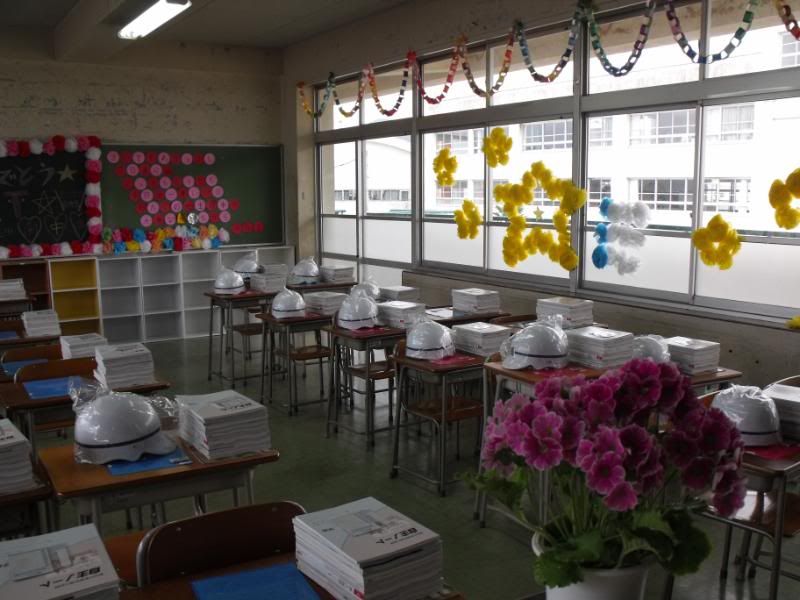
Now, for many, a new school year doesn’t mean much more than just a return to the same schedule after a short break. For others, like the 7 new teachers and 161 new students that just entered my junior high school, it means a brand new life. And in the case of the students,that includes 2 brand new uniforms, brand new gym clothes, a brand new school bag (which is an official school duffel bag and a complete change from the hard and sturdy backpacks they used for the last 6 years), 2 brand new pairs of shoes, and, of course, new teachers and new classmates.
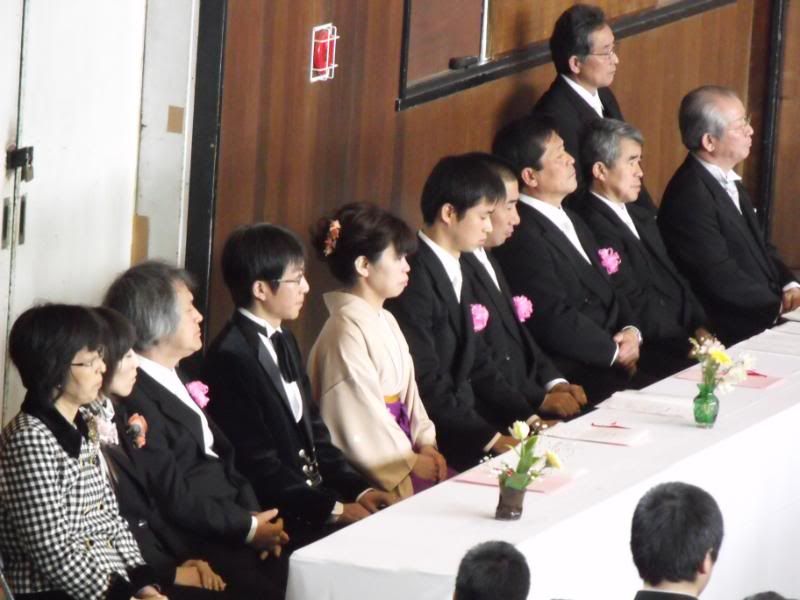
Oddly enough, at least to me, beginning your time at a new school is so important that there’s a big entrance ceremony to commemorate the occasion. While it was rehearsed less than the graduation ceremony, it seemed to be much more important. At least, that’s the feeling I got from the parents. While there was a good crowd at the graduation ceremony, which was held barely a month ago, the entrance ceremony was packed. We had to put out more chairs to accommodate the happy and tearful parents. It also felt like it was more important because a lot more of the mother’s were dressed in kimonos, while the only kimono to be seen at the graduation was worn by one of the teachers.
Actually, now that I think about it, the level of importance of the two ceremonies seems to be complete opposite. What I mean is, the graduation ceremony was held in great reverence by the teachers and the school in general. There was a lot of prep time, the teachers were dressed to the nines, and it just felt like a very important occasion. While there were parents there, and they were dressed nicely, it didn’t seem like that big of a deal, especially when compared to the kind of reception a graduation back home gets. Then there’s the entrance ceremony. Very little time was spent getting ready for it, the rehearsal took thirty minutes, while the teachers were dressed nice, they weren’t dressed as nicely as they were for the graduation and it just felt like an average ceremony. But the parents came out in huge crowds, were dressed a lot more formally, and just seemed like this was one of the most important ceremonies that they could attend. Interesting how the two different parties put different levels of importance on the two ceremonies.
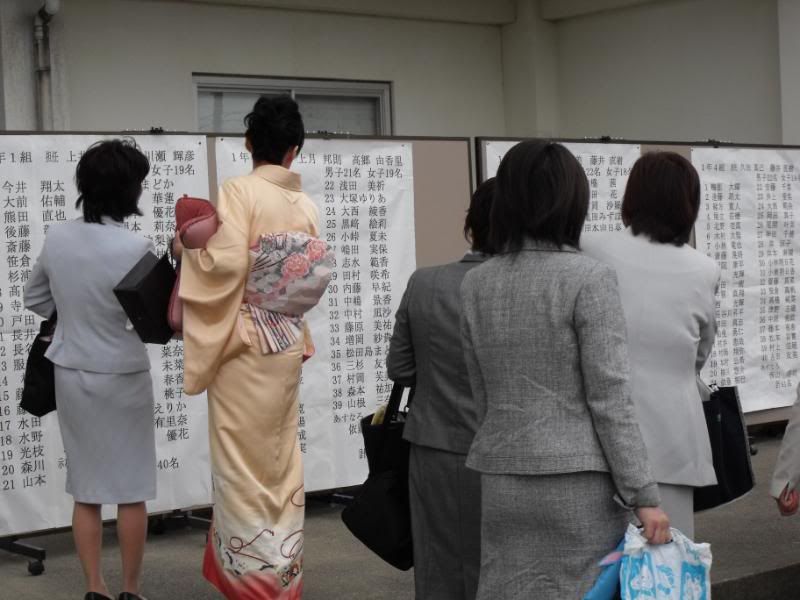
Speaking of the parents, it was really cute to see them get excited about the class placement of their child. Before a new school year begins, the teachers have a meeting and divvy up the students into equal classes. Right now, there are four classes for each grade at my school. Every year, the students are separated into different classes. It’s fun to watch the students crowd around the board that lists each class. There’s a lot of commotion; squeals of delight by friends who discovered that they’re in the same class, mummers of unhappiness from the students who are stuck with a less-than-favorite person, and just general pushing and shoving of people trying to find their name somewhere on the giant list. Today, not only did the first year students act this way, but their parents also did before entering the gymnasium and finding a seat. Many parents also took photos of their child’s name on the list, or a photo of someone pointing to their child’s name. It was quite entertaining to watch these groups of grown people act like, well, junior high students.
As for the new students... eee... they’re so cute! Some of them are so tiny they barely fit into their uniforms. But I know that won’t last long. They’ll fill them out before the year is done. Still, it should be a fun year. I can’t wait to get started!
Wednesday, March 10, 2010
Graduation, Part 4: The Final Farewell
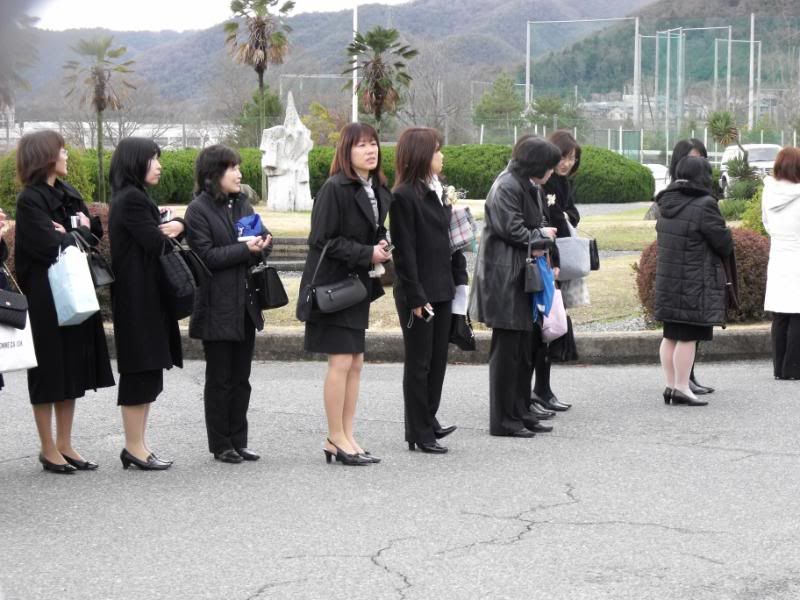
It turns out the ceremony is much more important to the family than I was lead to believe. A lot of families, not just the mothers, came. Everyone was dressed in their Sunday best, and a lot of women were wearing corsages pinned to their outfits. A few mothers were even drying their eyes as they watched their children walk out of off the school’s grounds for the last time.
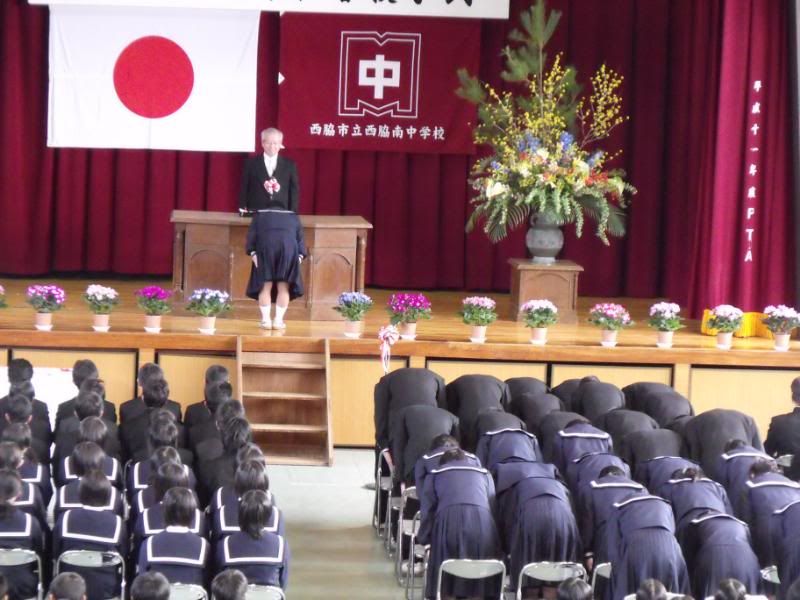
The ceremony was pretty much what I thought it would be, and was pretty much like a western graduation ceremony. There were long speeches, there was singing, and there was a lot of bowing. Actually, because they’re a bowing society, the only thing that really surprised me was that we didn’t clap after any of the speeches, only slightly bowed. This made the ceremony a lot more solemn and boring than some others that I’ve attended. There was no hooting and hollering as people stood to accept their diplomas. There was only a room full of quiet reverence. And the sound of camera shutters clicking.
All in all, it was a decent enough graduation ceremony. But note to self: dress up as much as you can next year. Since the students can’t dress up for this important occasion, it’s up to the teachers and parents to pick up the slack.
Graduation, Part 3: Singing
So it comes to no surprise to me that the school has its own anthem or that the students must sing a few songs at the graduation. Of course they will sing the school anthem, which I plan on memorizing before the ceremony, the traditional graduation song, and a special song the first year and second year students have been learning for the third years.
When I first heard the graduation song, you can imagine my surprise when I recognized the melody for “Auld Lang Syne.” The Japanese graduation song is called “Light of Fireflies” which is in reference to in the old days when students study by a jar of fireflies. Not sure why they didn’t use a candle, but the imagery is quite nice. Here’s the lyrics:
hotaru no hikari, mado no yuki. Light of fireflies, snow by the window,
fumi yomu tsukihi, kasane tsutsu. Many suns and moons spent reading
itsushika toshi mo, sugi no towo. Years have gone by without notice
aketezo kesa ha, wakare yuku. Day has dawned; this morning, we part.
tomaru mo yuku mo, kagiri tote, Stay or leave, either an end
katami ni omofu, chiyorozu no, Think as mementos; so many
kokoro no hashi wo, hitokoto ni, Corners of my heart, in one word
sakiku to bakari, utafu nari. Sing for peace.
There are two other verses, but these two verses are what my students sing. I think it’s quite pretty. Not as good as “Everybody needs Sunscreen” but a lot better than “Graduation (Friends Forever).”
Tuesday, March 9, 2010
Graduation, Part 2: On the Road to Perfection
I remember my graduation rehearsal: Is everyone here? Okay? Good. Line up in alphabetical order. Remember who you’re standing beside. Now we’ll walk in and sit down. Great. Now this is where you will walk when you get your diplomas. Got it? Great. Now get outta here.
Okay, maybe it wasn’t that cut and dry, but it was probably that quick.
My students’ rehearsal isn’t as simple: Okay classes, line up in alphabetical order, boys first and then the girls. Now we’re going to march into the gym. Class two, don’t enter until class one is at their chairs! Keep standing until everyone is here. Bow! No, you’re not bowing together. Again! Okay, sit down! Stand up! You’re too slow! Again! Bow! You’re standing up too fast! Again! Bow! Too fast! Again! Bow! 1…2…3… okay, now sit. No! Again! Again! AGAIN!
I can understand why they dedicated a whole hour to this. If the students don’t stand, bow or sit with just the right timing, they have to try again. If the students don’t bow low enough, a teacher will come and push their head down until they have reached the desired 90 degree angle. And there’s a lot of bowing happening.
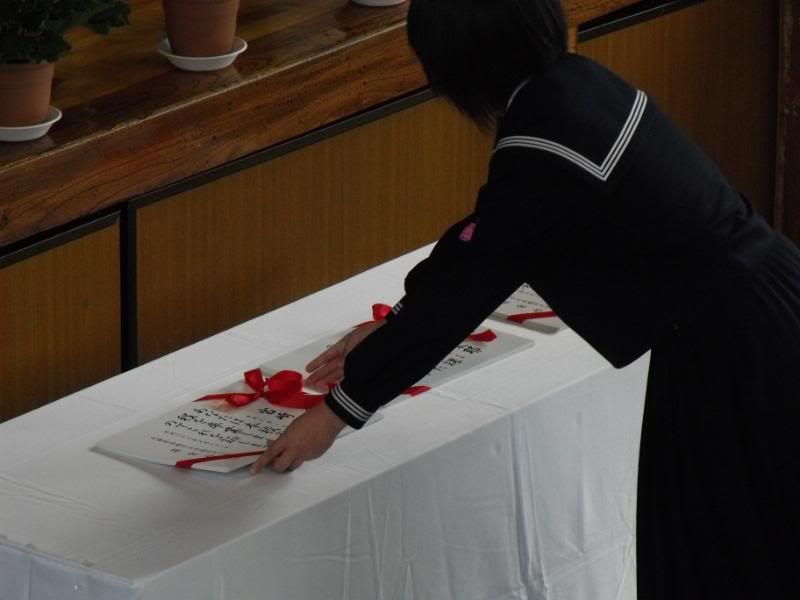
From what I can see, each student will not come up to the podium to receive their diploma from the principle. Instead, the class rep will be summoned and then he or she will make their way to the front of the stage, turn to the VIPs and bow, then turn to their homeroom teacher and bow, make their way up the stairs to the podium on the stage and then bow, in perfect sync with the rest of the class, to the principle, get the diplomas, make their way down the stairs, bow to everyone again, and then finally sit down. After the ceremony, the homeroom teachers will hand out the diplomas to the students in their classroom.
It’s not a lot of work, really, but the expectations are very demanding. The students seem to understand though. This is a very important day and they can’t embarrass themselves or their school. This is just what’s expected of them.
Graduation, Part 1: Who Cares
I’m still trying to figure out if graduation is a big deal in Japan. I know in Canada, or at least in my family, high school graduation is a pretty big deal. While the ceremonies are long and tedious, they are attended by many family members to help support the new graduate. But in Japan, the graduation ceremonies are held on a weekday, during school hours, and are maybe attended by the student’s mother. This lack of family support is why I don’t think they’re such a big deal.
But on the other hand, the ceremony does last 8 hours, there is a lot of prep work beforehand, and the younger students even put on a fun assembly for the graduating class prior to the graduation ceremony. And this is just for a junior high school graduation.
Then again, graduating from junior high might be as far as some of these students get. Not to say that any of my students are so dumb and apathetic that they won’t be able to make it through high school, but I’m referring to the fact that high school in Japan isn’t compulsory. I know a bunch of people I went to high school with (you know who you are) would have loved the option to get out of more schooling, but even though they don’t have to go to high school 94% of Japanese students do go on.
Is graduation a big deal in Japan? From the point of view of the school and the students, it is a very big deal. Last week I enjoyed a four hour assembly that featured the first year (grade 7) and second year (grade 8) students, as well as the teachers, dancing and acting in silly skits for the third year (grade 9) students. They sang, they danced, they bopped each other on the head, they fought evil and they never stopped saying “thank you,” to the third years. It was funny and a little sad at the same time.
So while the graduation may not be a big enough deal to get Dad or the grandparents to attend, it is a big deal. They just express it in different ways.
Monday, January 11, 2010
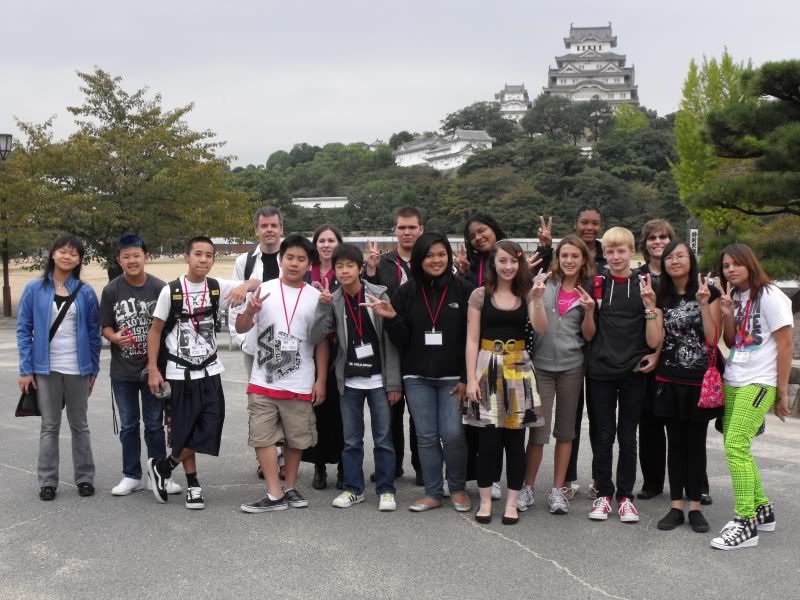
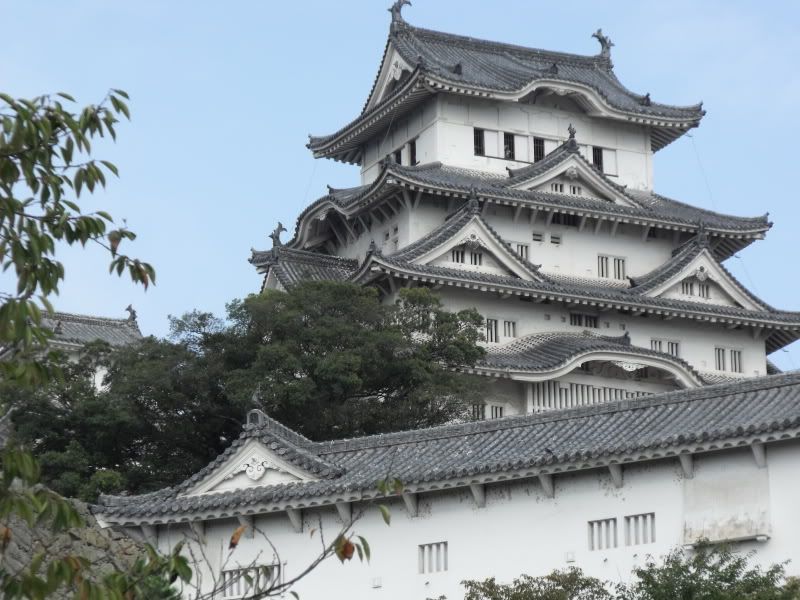
Sightseeing with Koren-sensei
Wednesday, December 9, 2009
English Playtime with Koren-sensei
No, wait, “teach” is too strong a word. I do teach them a small handful of English words, but for the most part, we just play games. Which is probably why I’m so popular, but popularity has its price to pay. For example: when I’m not in class, I’m in the teacher’s office, when it’s time for class someone escorts me to the classroom. The other day, when the grade one teacher told her students she was going to get me, they decided she wasn’t allowed to go alone. As soon as I crossed the threshold of the teacher’s office, I was tackled by 15 grade one students who all wanted the chance to greet me with a hug. Then, after lunch, two little girls came to the teacher’s office, meekly called out my name, and asked me to go play with them (in Japanese). Oh, and a big thank you to my mom for giving me a name that perfectly translates into Japanese. I’m still not used to people saying my name right on the first try.
So about now you’re probably wondering how I communicate with these children who don’t speack English, since I don’t speak Japanese. In the classroom, it’s really easy. If I want them to move their desks, I point to their desks and say, “this is a desk,” and then point or gesture to where I want them to move it to while saying, “move them (direction/place).” Teaching is just as easy, because the students are trained to repeat whatever I say when I’m holding up a flashcard, and they understand that this word I’m saying means whatever is on the flashcard.
Giving directions to a game or activity is just as easy. I simply act out what I want them to do and they do it. If the game is a little more complicated, like Simon Says, their homeroom teacher will jump in and help with some translations, but for the most part, it’s not necessary.
And that’s what it’s like to teach the younger students. One day I’ll remember to bring runners with me so I can keep up with them on the playground.
Saturday, October 3, 2009
Sports Festival
First off, each sports festival starts off with an opening ceremony. Each grade and class (each grade has about 4 classes within it, with about 35 students in each class) marches around the field. They are lead by the student chairmen of the event, as well as some students who carry the school’s flag, the Japanese flag, and a banner that represents the theme of the sports day. During the march, the school band plays a nice marching tune the sets the mood.
Then there’s the actual events. Each race is a team event to help support the Japanese motto “it’s about the group, not the individual.” There were a bunch of different relay races and then the really cool races.
There was a really cool race called the caterpillar race. The classes were divided by their genders and raced from one end of the field to the other, and then back again. Here’s the catch, each team and one person who ran across the backs of their teammates. Once you’ve been run upon, you have to stand up, run to the end of the row, bend over and wait to get run upon once again. If the runner falls, the next person to be stepped on has to get on all fours and act as a step. It was a really interesting race to watch. Especially since I knew nothing like this would ever happen in Canada.
There was another cool race to watch. Each class was lined up in rows of four. A group of four would hold onto a giant bamboo rod, run to the other end of the field, go around two pylons, and run back. When they got back to their team they had to drag the rod under their team, who jumped over it as it came, and then bring it to the front and hand it off to the next group of four.
There were also some tug of war games and a two-legged type of race, only the whole team was tied to each other.
The other events were much larger events that took a lot more time to practice.
The grade 8 & 9 girls did two really good dances that are based on a very popular dance style in Japan called Para Para. It’s like line dancing, but it’s more for a group and focuses mostly on arm and hand movements rather then leg movements. It was very well done, but the girls weren’t smiling. A few of the female teachers and I tried to get them to smile while they danced, but they were too busy concentrating on the dance movements to think about smiling. Oh well…
The grade 7 kids performed a traditional Japanese dance. Tradition Japanese dances are always based on some sort of work. This one was based on being fishermen. Their actions represented pulling in the nets and throwing the fish into the boats. Or at least, that’s how it was explained to me. I found it really cute cause there was a lot of “e-yah”s shouted, and the grade 7 students have very high pitched voices.
The, for lack of a better term, gymnastics that the grade 8 & 9 boys did were simply amazing! They displayed such feats of strength and agility and danger that I know would never be allowed in a school function anywhere in North America. One thing they did was a simple pyramid made up of 6 students. Wanna know how they got down? They just flattened themselves and fell onto the sand below. And that field is all sand. All the way down. Another amazing feat was called the fan. It included 5 people, one in the middle holding the other four up who were leaning towards the group. My favorite was called the wave. A group of boys got on their knees, locked arms and moved as a group to simulate the movement of a wave across the horizon. Then the coup de grace was a 7 layer pyramid, with the boy on top standing and holding a banner. The banner the top boy held said something about the school celebrating its 50th anniversary. Those boys actually climbed on top of each other to get to their spots, and then climbed back down again. Which is good, cause I think one boy went home one day with a broken rib or something from falling from one of these stances.
It’s probably a good thing we don’t try this stuff back home.
So that was the sports festival. It was so interesting to watch and learn more about Japan through this activity. And after wards I got to go to a dinner party with my co-workers and watch them make their own pyramid in the restaurant after they had one too many drinks. Yeah, I work with a crazy bunch.
PS - Sorry there's no pics, but I promised my principal that I wouldn't post them on the Internet.
Monday, September 14, 2009
Okay, but what about the frogs
But what really got everyone interested was my fun fact that Winnipeg can get as cold as -40 in the winter and we get about 20 cm of snow. In a place where they never see temperature drop past -2, they have a hard time imagining this. And not only the students, the teachers to.
Now that so many have seen my slide show, I've been bombarded with questions, which usually need a few translators around me to try and get to everyone.
I've been asked about things like if the inside of your nose freezes, what happens if you don't wear enough warm clothes, and even what happens to the snakeS and frogs during the winter months.
It's been an interesting week, that's for sure. I just hope I answered all the questions correctly. But, what does happen to the frogs?
Monday, August 31, 2009
Hajimemashite, Koren-sensei!
While it was a great day of learning about my new home and how to live in Japan, it was mostly about meeting people. So many people that tomorrow I'm gonna have the fun job of apologizing and asking for people's names again.
First I was taken to my Board of Education to meet the people in charge. It was a weird kinda interview. It was like an interview in the sense that they were asking me questions about my previous experience with children and teaching, but it was extra weird cause they didn't speak English so I had to have a translator.
Then I was driven to the three schools that I'll be teaching at. Each school I went to had one teacher who spoke English, but their skill levels lessened at each school I went too. It will be interesting to see how well I can learn to communicate with adults who don't speak English. Good thing I rock at charades.
Everyone I met was very impressed with my Japanese, which was very nice of them since I really don't know all that much. Yeah, I know enough to get around and get things done, but for the most part, I have no idea what anyone is saying to me. Still, anytime I used a new word they were very impressed. It almost seems like they are just humoring me, but I know they are actually impressed that I know more than just "sayonara" and "arigato."
But tomorrow is my first day of work, so we'll see just how impressed they are with me then.