Showing posts with label Japan vs North America. Show all posts

Wednesday, April 7, 2010

Beginnings

Spring brings more to Japan than just pretty colored trees.  Spring also marks the beginning of a new school year.  While all around us nature is refreshing and beginning anew, so is our school.  I kinda like that.  Spring has always been used as a metaphor for beginnings, so having the new school year start in the spring makes sense.  With the long break in the summer, it doesn’t necessarily work as well as having the school year start after the long break, but it still makes sense.

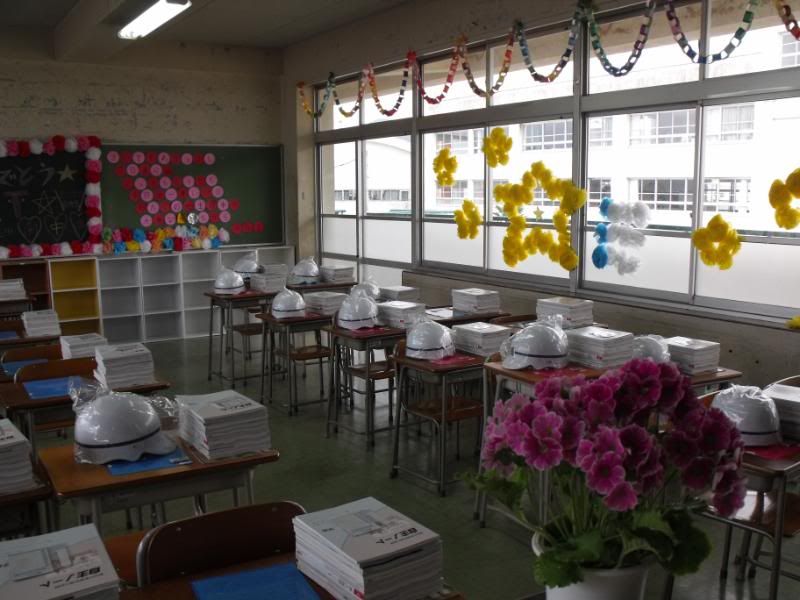
Now, for many, a new school year doesn’t mean much more than just a return to the same schedule after a short break.  For others, like the 7 new teachers and 161 new students that just entered my junior high school, it means a brand new life.  And in the case of the students,that includes 2 brand new uniforms, brand new gym clothes, a brand new school bag (which is an official school duffel bag and a complete change from the hard and sturdy backpacks they used for the last 6 years), 2 brand new pairs of shoes, and, of course, new teachers and new classmates.

Oddly enough, at least to me, beginning your time at a new school is so important that there’s a big entrance ceremony to commemorate the occasion.  While it was rehearsed less than the graduation ceremony, it seemed to be much more important.  At least, that’s the feeling I got from the parents.  While there was a good crowd at the graduation ceremony, which was held barely a month ago, the entrance ceremony was packed.  We had to put out more chairs to accommodate the happy and tearful parents.  It also felt like it was more important because a lot more of the mother’s were dressed in kimonos, while the only kimono to be seen at the graduation was worn by one of the teachers.

Actually, now that I think about it, the level of importance of the two ceremonies seems to be complete opposite.  What I mean is, the graduation ceremony was held in great reverence by the teachers and the school in general.  There was a lot of prep time, the teachers were dressed to the nines, and it just felt like a very important occasion.  While there were parents there, and they were dressed nicely, it didn’t seem like that big of a deal, especially when compared to the kind of reception a graduation back home gets.  Then there’s the entrance ceremony.  Very little time was spent getting ready for it, the rehearsal took thirty minutes, while the teachers were dressed nice, they weren’t dressed as nicely as they were for the graduation and it just felt like an average ceremony.  But the parents came out in huge crowds, were dressed a lot more formally, and just seemed like this was one of the most important ceremonies that they could attend. Interesting how the two different parties put different levels of importance on the two ceremonies.
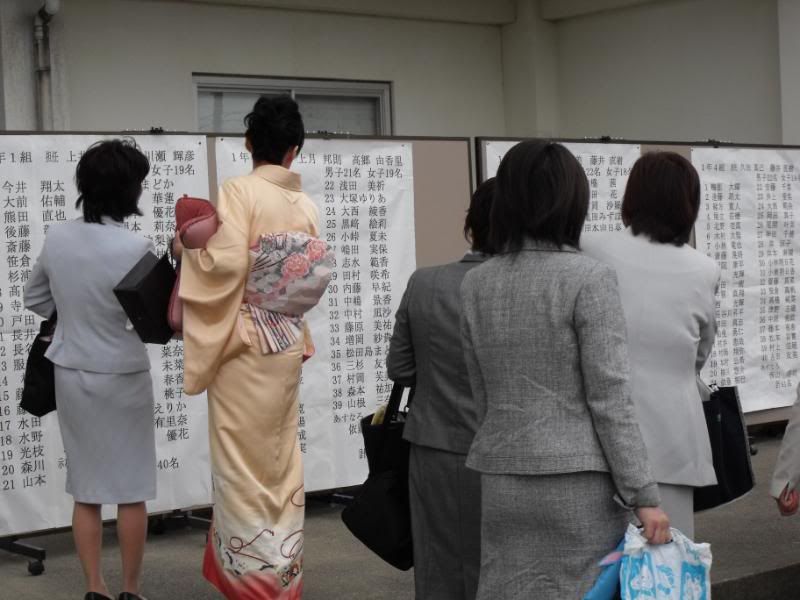
Speaking of the parents, it was really cute to see them get excited about the class placement of their child.  Before a new school year begins, the teachers have a meeting and divvy up the students into equal classes.  Right now, there are four classes for each grade at my school.  Every year, the students are separated into different classes.  It’s fun to watch the students crowd around the board that lists each class.  There’s a lot of commotion; squeals of delight by friends who discovered that they’re in the same class, mummers of unhappiness from the students who are stuck with a less-than-favorite person, and just general pushing and shoving of people trying to find their name somewhere on the giant list.  Today, not only did the first year students act this way, but their parents also did before entering the gymnasium and finding a seat.  Many parents also took photos of their child’s name on the list, or a photo of someone pointing to their child’s name.  It was quite entertaining to watch these groups of grown people act like, well, junior high students.

As for the new students... eee... they’re so cute!  Some of them are so tiny they barely fit into their uniforms.  But I know that won’t last long.  They’ll fill them out before the year is done.  Still, it should be a fun year.  I can’t wait to get started!

Sunday, February 14, 2010

How the Japanese do St. Valentine's Day

Japan has a serious crush on Western culture. They like to celebrate our holidays, but to a foreigner, it seems like they didn't quite get the point. I don't know when the celebration of St.Valentine's Day came to Japan, but, once again, it seems like they got something mixed up in translation. That, or maybe they figured out how to do it right. Guess it's how you look at it.

To start off, Valentine's Day is all about showing loves to only males and we show that love through chocolate. The stores are filled with premium chocolates and truffles, heart-shaped cakes and accessories for making your own homemade chocolates. Apparently love isn't real unless it's expensive or homemade.

As a foreigner, it is very odd to see all these boxes of chocolate which have been packaged and made with men in mind. I'm sure any guy would like a smartly wrapped blue box of French truffles, or a few chocolates with Dragon Ball Z characters etched into them. Actually, the whole holiday is extra odd since a lot of the homemade chocolate making kits include Hello Kitty molds and most of the wrappers are pink. 

While this seems very one sided, don't feel too bad for the Japanese woman.  March 14th is White Day or Return Day.  A very special day when all this love and hard work is returned.

I wonder what the proper return gift is for a box of chocolate covered almonds and a delicious breakfast?

Monday, January 25, 2010

Surviving the Japanese Winter

First off, let me say that as a native Winnipegger, I'm not finding the "winter" weather so harsh that surviving is difficult. But the Japanese have their own way of battling the elements that is completely different than our own North American ways, which is why I've decided that is worthy of being mentioned.

How different, you ask? For starters, Japanese buildings aren't insulated. Insulation is something very new to Japan. If you live in a building that has been built in the couple of years, you have a high chance in being in a rare insulated building, but even then, it might not be as insulated as a western building. While you may be fortunate enough to have insulation, you still won't have central heating. During my adventures around Japan, I've noticed that only places of business seem to have any kind of ventilated heating system.

The really bad thing about the lack of these two familiar things is that when it's cold outside, it's cold inside. Yeah, 10ÂșC may not be cold, but when you're constantly surrounded by it, it gets pretty uncomfortable. This is especially true of my jr high school which doesn't have closed in hallways, so when you open a door, you're outside again. There's very little protection from the elements.

See? It's pretty crazy, right? But do not give up hope, reader! There are few simple ways to stay warm.


Blankets: The easiest way to stay warm is, of course, to wrap yourself up in a blanket. And I don't just mean at home. It seems to be a perfectly, socially acceptable to wrap your legs in a blanket at work. Almost every teacher at my school has a blanket draped over their chair. The women's blankets are predominantly designed with some sort of cartoon character, while the men's are a simple design along the lines of stripes or polka-dots. Mine is purple with black cartoon cats on it.


Hand warmers: I've only ever seen hand warmers in the movies, and even then, never in a Canadian movie. Hand warmers are little packets that magically warm up and keep you warm you up when you hold onto one. They're very popular and inexpensive. You can buy a box of 30 for about ¥500 ($5).


Electric Space heaters: Space heaters in Japan vary more than anything else in Japan. They come in various shapes, sizes, power levels and even power sources. You can choose a kerosene/electric hybrid, or just an electric heater. You can buy a large one that resembles a radiator or a tiny round one that fits on your table. Japanese air conditioners also come with a heating function, but they use a lot of energy and it takes a long time for the whole room to fill with warmth. The down side to these heaters is that they are very drying. To counter this, some of the more extravagant ones come with a humidifier option.


Kerosene Space Heaters: These space heaters seem to be very popular in Japan. I've not only seen them in homes, but all of my schools have one, and there's one in every classroom. Why they're so popular is a bit of a mystery to me. They don't seem very convenient, but they do heat up a room quite quickly. A kerosene heater needs to be plugged in order to turn on, but needs kerosene in order to run. The heater starts a fire and keeps burning until you turn it off, or it runs out of gas. Of course, it running out of gas means that you'll have to take a trip to the gas station to get some more. Another downside to the kerosene heater is that it can't be equipped with a humidifier, like its electric rival. Instead, it is common to see a large metal pot or metal kettle placed on top of the heater to allow a small amount of steam to be added to the room. While they do their job very well, I'll never buy one for my place. Not only is it inconvenient, but they are so very dangerous (c'mon, it's a caged fire!) and the smell of burning kerosene is not a pleasant one.


    Kotatsu: Ah, the kotatsu. One of Japan's neatest inventions. When asking around if I should buy a space heater or a kotatsu, everyone agreed that a space heater is more practical, but that kotatsu are much more comfortable. A kotatsu is a table with a heater built into the underside of the table top. You place a blanket or rug on the floor and then place the kotatsu over that. The top of the table is removable and you place a large, thick blanket under the table top so it drapes over the edge and onto the floor. Then you turn it on and get all cozy under the blanket. It's easy to see why it's not very practical. The heat only stays under the table making it very hard to muster up the will power to leave.

    Mini-kotatsu: I don't think the Japanese refer to them as mini-kotatsu, but I know that these little pink boxes are referred to as a kotatsu, so I'm using mini to just help distinguish between the two. Anyways, a mini-kotatsu is a little heater for your bed. You place it under your sheets, plug it in, turn it on, and enjoy the electric warmth.


    Hot water bottles: When I say hot water bottles, you probably get an image of a soft rubber bottle that you apply to your body when you're not feeling well. The Japanese version is quite different from that. It is made of a very hard plastic that is shaped much like the mini-kotatsu, and like the mini-kotatsu, it is used to keep your bed warm. I don't know how well this item works, having never tried it. I'm still trying to figure out if it stays warm all night, or if it just makes your bed uncomfortable when the water finally goes cold.
      And there you have it, 7 easy ways to stay warm in Japan. Now if you'll excuse me, I'm going to curl up under my kotatsu and hibernate till spring arrives.

      Sunday, January 3, 2010

      New Years in Japan

      I love Christmas time. The sights, the sounds, the feeling of peace and joy on Earth. The love and merriment, and even the craziness. I love it all. Sadly, Christmas is not a big holiday in Japan. The Japanese are so in love with western culture that they try to copy our big holidays, but they seem to only copy the decorating part and miss the true joy of the holidays.


      So, needless to say, my Christmas in Japan was quite tame. I was lucky enough to have the day off, and I spent the time talking with family in Canada. I also went shopping to get a few last minute things for the Christmas dinner Kris and I had with our friends. It wasn't a bad Christmas, just not a Christmas I'm used too. There wasn't even any snow!

      But don't think just because there wasn't a grand Christmas that Japan is lacking on holidays. They have more than enough of their own. For starters, they have two four-day h
      olidays; one in the spring called Golden week, and one in the fall called Silver week. They also have a whole slew of holidays thrown into their year. So many that it seems like I have a stat-holiday at least once a month. But the big Japanese holiday is New Years.

      Un
      like us, the Japanese aren't big on staying up till midnight to watch a glittering ball drop. If they do decide to stay up late, they'll stay up all night to watch the sun-rise. Many temples accommodate this tradition by having a festival all night that offers food, beer and other sundries to visitors. Then, on January 1st, thousands of people gather to the shrines and temples (don't ask me the difference between the two cause I have no idea).

      While they do enjoy the festival, the big thing is to make an offering at the temple, ring the bell, and pray for good fortune for the upcoming year. After the prayer, you can purchase a multitude of charms and horoscopes. If you have a horoscope that predicts misfortune, you tie it to a tree (or any spot that has been dedicated to this custom). Some shrines (like the one we went to) also offer other mini-shrines you can make offerings to and pray to. These shrines are dedicated to a certain cause. For example, if you are a student preparing for your entrance exams for high school or university, you might make an offering to a shrine for education.

      The shrine that we went to is pretty popular because, apparently, it specializes in car blessings. The cars line up at the front of one of the shrines and then everyone gets out of their car and goes inside. I have no idea what happens in there, but after a very long time, they come out and enter their cars. The monks from the shrine come outside and stand on the balcony and do a special car chant, complete with gongs and bells. Once the chant is done, a few of the monks walk amongst the cars with large poles that have a bunch of papers attached to them. I don't fully understand the papers, but they are folded a certain way to make them good luck charms. Anyways, the monks wave the poles around the cars while chanting. Once they are done, the cars leave the parking area, and the next group comes in.

      Visiting the shrine is only one of the new years traditions. The other main tradition is the family time. Children (no matter what their age) return to their parents' home. They usually stay from the first until at least the third. During this time, no cooking or cleaning is supposed to be done. Which means that the poor mother is cooking like a mad woman on the thirty-first so that everything is ready for the upcoming feasts. I don't know a lot about these feasts, but I do know a bit about the food. One common new years food is zoni, which is a special vegetable and chicken soup. This soup is made with toasted mochi (rice cakes). We made it for our new years dinner and it was really yummy. Definitely something we'll make again.

      Other foods that are common to new years are these boxes filled with different types of vegetables and seafood, like whole shrimp. The boxes should be assembled at home, but you can buy them from stores in advanced and have them delivered to your home either on new years or just in time for new years. But these boxes don't come cheap. The grocery store in the mall was selling them for about $100. I think I saw even some at 7-11 for $35. I don't know the full story, but each food has a special meaning, like long life or prosperity or something else depending on the food. Each thing is supposed to help bring good luck in the new year, and chase off evil spirits.

      Since all this time is being spent with the family, a lot of places are closed until the 3rd or 4th. It's not as bad as I thought it would be. My bank's ATMs are open, but I've noticed a few that are closed. The big chain stores are open, but a lot of the smaller, family owned places are closed. The buses and trains are running, but a lot of them are running on a holiday schedule. Even some of the tourist destinations are closed.


      The stores that are open offer "Happy Bags." Depending on the store and the items, a happy bag can go for $5-$100. They are filled with items from the store. Each store has signs and pictures of what is in the happy bag. I've seen happy bags filled with candy, clothes, picnic supplies and even stuff for the kitchen. Its a pretty cool idea, and one that works really well with another new years tradition: money envelopes.


      I guess its okay that they don't have Christmas, because they have this tradition instead. On New Years day, parents give their children, under the age of 20, envelopes filled with money. From what I've been told, the older you are, the more money you receive. Many of my jr high school students will get $30-$50. The envelopes here are really cute, too. They have many different designs, from flowers, to the animals of the Chinese zodiac, to popular characters like Disney Princesses and Thomas the train engine.

      The last tradition that I know about is New Years cards. The idea behind them is similar to Christmas cards. You buy, or make, cards that wish the people in your life good luck in the upcoming year. These cards are such a big deal that the post office guarantees delivery of your cards in time for new years as long as you drop them off by a certain time. The only major difference between these cards and our Christmas cards is that they don't sell them in bulk. Of course, in North America, you can go to almost any store and buy a box of Christmas cards for a few dollars. In Japan, you can buy new years cards from most stores or the post office, but they all go for 50¢ a card. Which can get really expensive really fast. I know the teachers I work with are buying them not only for their friends and family, but also for their homeroom students and students that are in the clubs that they supervise.

      Japanese New Years might not be as awesome as Christmas is, but its still really interesting to experience this culture and enjoy their holidays and traditions.

      Tuesday, September 1, 2009

      Culture Shock

      I don't think culture shock is a good title, but it's better than the "differences between Japan and North America." I'm not going to bother with the obvious differences, like bowing and school uniforms, but the real differences that will take foreigners by surprise.

      1. The kids are kids: The Jr High girls are sweet and innocent, complete with ponytails. If they're trying to be anything, they're just trying to be cute, unlike their North American counterparts, who are busy trying to be dirty be-autches.

      2. Shopping: You pack your own stuff. Yeah, not too different from some places in Canada, but how they go about it is different. You bring your basket to the cashier, who takes an empty basket and puts it on the counter. They then take items out of your basket, scan them and stick them in the new basket. Once they're done that, they hand you a bag or two, you pay, and then you move down to the packing station. The packing station even comes with those little bags you use to wrap your veggies and fruit in. Also, when you're in a grocery store, if you buy anything that needs to stay frozen and cold, you're directed to a dry ice machine and you use to fill the bag with your frozen goods in it. It's so cool!

      3. Taxi: Small fact, the taxi's have doors that automatically open and close. They look and work like a regular door, in the fact that they swing open, but the driver has a button he presses to open and close the door.

      4. Bikes: Bikes seem to be the major mode of transportation here in the land of the rising sun, and man, do they have it down to a science. The kick-stand on my bike back home was not a sturdy or reliable device. In fact, I spent many weekends tightening it. Here though, the kick stand is not just a thin piece of metal that has to rely on physics to keep your bike from falling over. It's a larger piece of metal that goes under your back wheel and keeps the whole thing from tipping over. Then there's the bike lock. It's a little half circle that's attached to the back wheel that comes with a key that needs to be in the lock while the bike is in use. This is extra helpful to those of us who are prone to losing things. Like keys. Sorry if these wordy descriptions are not enough to paint a proper picture. I'll try and take photos of my bike tomorrow.

      5. The blind: I have yet to see a blind person, but Japan is very helpful to the blind. They don't seem to have brail in odd places (like on the keys of a drive-though atm) but they do have it on the most interesting on places. For one, all the sidewalks have slight groves on them to help a blind person follow the path, and each street corner has small bumps on it. I'm not sure if all the merchandise has it, but shampoo has bumps on the side of the bottle so blind people can tell the difference between it and conditioner. Such a neat idea.

      That's all for today, but as I explore this vast land, there will be more tales and other comparisons.