Friday, June 25, 2010
Golden Week Adventure - Part 5
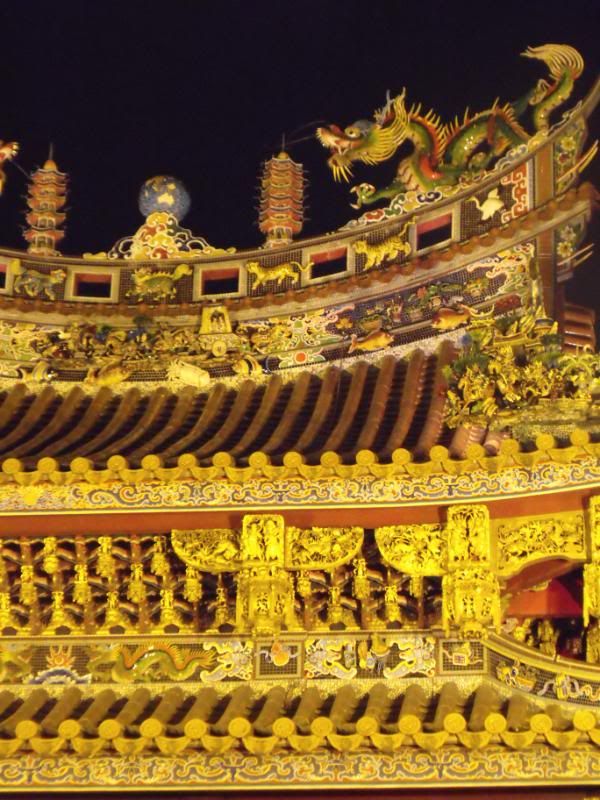
I had a large list of places that I wanted to visit, and on the top of that list was The Golden Pavilion (Kinkakuji), Fushimi Inari Shrine, Gion District and Toei Movie Village. Luckily, we were able to do it all.
But first, since we did spend the night on an overnight bus, we were in need of a stop at our hostel and a shower. I need to spend a few moments gushing over how awesome our hostel was. We stayed at K’s House Kyoto and it was the most beautiful place I have ever spent a night in. The lounge areas were beautifully decorated, comfortable and offered games, travel books and a TV with movies. The shower and bathing areas were so amazing I think a few of us snapped some photos of them. Adjacent to the hostel was a small bar/cafĂ© that offered a decent breakfast buffet for \600 and cheap drinks and food for night caps. The staff was also super friendly and helpful. They helped us with our luggage, called us a cab when we left, helped us with maps and gave us travelling tips, and they never lost their patience when dealing with less than polite customers. The hostel is also a short walk from Kyoto Station, close to a few gardens and temples, and offers bike rentals. If you’re going to stay in Kyoto I highly, and I mean HIGHLY, recommend this hostel. Just don’t go when I am, I don’t want to have to fight to get a reservation.
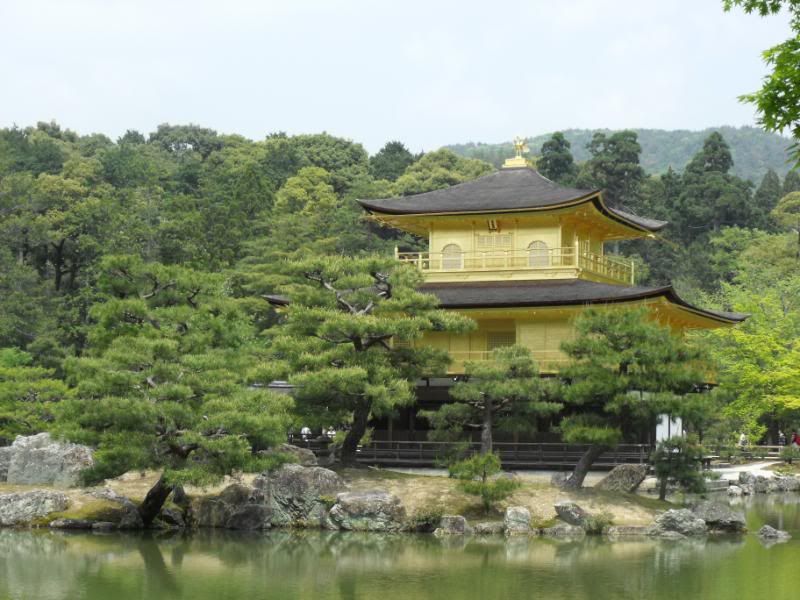
Showered and refreshed, we made our way to The Golden Pavilion. It’s called The Golden Pavilion because the two top floors are completely covered in gold leaf and topped with a golden phoenix. The Golden Pavilion is a zen temple that was built in the early 1400’s, but has been burned down and rebuilt numerous times over the years. This current building was built in 1955. It was built overlooking a “reflective pond” that is supposed to help people enjoy the beauty of the temple. In the gardens, you can enjoy other temples, a coin toss, and a food hall where you can try Japanese sweets and matcha which is very bitter green tea.
On our way to The Golden Pavilion from the subway, we passed by Daitokuji Temple, and decided to make a small detour to check out this expansive temple complex. There are so many temples, gardens and well groomed paths that it’s kinda like being in a temple village. Being inside this area, it’s really hard not to feel peaceful and at one with nature. Wow, these old monks knew what they were doing.
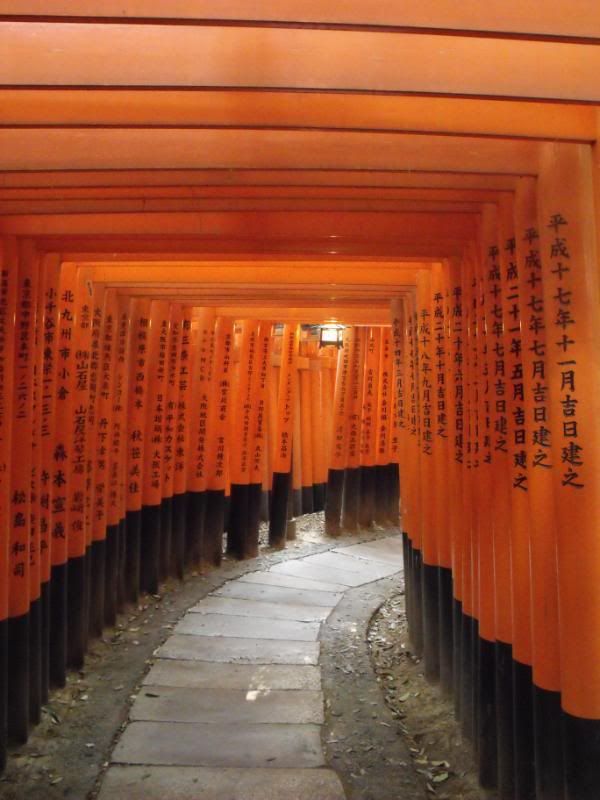
After lunch, we headed to Fushimi Inari Shrine. I really wanted to see this shrine because it just looked so beautiful on the travel websites I visited while planning the vacation. Fushimi Inari Shrine is made up of miles of paths that go through a wooded mountain behind the main shrine. Along the paths you walk under thousands of torii gates (the red gates). It’s simply breathtaking. When we got there, it was later in the day so the sun was a little lower and was just barely streaming in through the spaces between the gates. Really, I don’t have the talent necessary to express just how beautiful it all was. I don’t think even Shakespeare had the talent for that. It can take up to two hours to walk through all the trails. Since we were now on day four of our walking-around-tour of Japan, we were pretty beat and didn’t have the energy to complete it. According to a small girl that was walking behind us and counting stairs, we walked well over 1000 stairs, so I’m pretty proud of that.
Besides the thousands of torii gates, Inari Shrine is famous for being a shrine to Inari, the god of rice. It is believed that foxes are his messengers, so throughout the shrine you can see fox statues. There are also numerous food stands throughout the shrine that offer kitsune udon (a soup with fried tofu and thick noodles) which is thought of as the favorite food of these spirit foxes.
To end the day, we decided to head over to Gion for dinner and to hunt down some Geisha. Gion is the place to go if you want to see Geisha. Since it is Golden Week, which should be called “filled with tourists week” the Geisha were in hiding. Other times, if you walk around Gion, you might catch a glimpse of a Geisha or a geisha apprentice walking through the streets. During Golden Week, anyone you see dressed as a Geisha is probably a tourist that has gone to one of the many businesses that will dress you up and take your picture (this is on my list of things to do while in Japan). You can also find tea houses and restaurants where Geisha entertain. These places are ridiculously expansive though. If you really want to see a Geisha, you can head to Gion Corner which holds a daily show, performed by actual geisha apprentices, and is aimed at foreign tourists. You’ll get a taste of the different geisha performances, like dances and a tea ceremony, and it will only cost you about \3150.
Besides Geisha hunting, Gion is just a really neat district to walk around. There is an area that is very modern and filled with expensive items from the latest designers, and then you turn the corner and you’re walking along a narrow street filled with wooden stores that sell Japanese fans, crafts and pickles. It’s quite the contrast that really represents Kyoto well; the new world living in harmony with the old one.
On our last day, we headed to Toei Eigamura, or Movie Village. It’s a theme park and studio. The area has been built to look like feudal Japan. There’s also a power rangers and cartoon museum. Giselle had been there before and said it would only take us about 2 hours to see the whole park. She forgot to take into account that we love cartoons and would play in everything that we could play in. Part of the park has a play area where you can see “movie magic” at work. You can stand in a jail cell with rubber bars, walk around a slanted house, ride a “falling” elevator, and get your x-ray taken, or become part of a giant’s breakfast. Seriously, we’re very silly adults, how are we not going to try all that out?
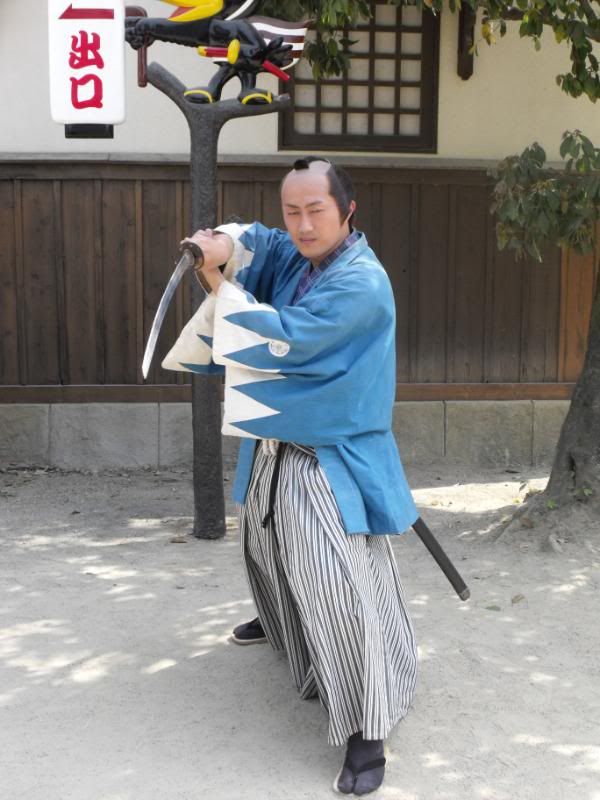
Then there’s the actual park. We watched a samurai show, took photos of samurai, saw a royal parade, saw a mountain god appear, got water sprayed at us from a lake monster and just had fun playing in all the different buildings. There was a jail, a mansion, and a regular looking house, just to name a few. If you have the money and the time for it, you can also get dressed up. There are expansive studios that dress you up to the nines, and then there’s simple booths were you can put a costume on over your street clothes. I think both of these places also give you the option of walking around in your new outfit. C’mon, how does that not sound like fun?
It was a fun place that I plan on visiting again and it was a good way to end our trip. We had used up all the golden week days and Giselle and I needed to get back to work. All in all, this was a great trip. Would I do it again? No. At least, not like that. But I learned a lot and I think I can make the next trip even better. And next time, I wanna see some monkeys!
Golden Week Adventure - Part 4
Yokohama is less than a half hour away from Tokyo by train and is Japan’s second largest city. Since it is a harbor town, it was one of the first ports that opened up to foreigners and was Japan’s gateway to the western world during the Meiji Era. It also has some great tourists spots, including the world’s largest Chinatown (outside of China), a beer factory with guided tours that include free samples at the end, and a ramen museum built to look like a Japanese market street from the 1950’s.
Kamakura is a much smaller town that is located only a few minutes from Yokohama. It is a very ancient city filled with shrines, temples and the Japan’s second-largest Buddha statue (don’t ask me why, but I have this thing for checking out overly large statues). The shrine that really appealed to me was Zeniarai Benten, a shrine located inside a cave where, according to legend, if you wash your money there it will double.
Unfortunately, we would not get the chance to see any of this. Well, all most all of it. Remember how I said that Golden Week is the busiest travel time in Japan? This day we learned just how true that was.
The plan was to go to Yokohama Station and leave our suitcases in one of the large coin lockers and then continue on our adventures. At the end of the day, we would be taking an overnight bus from Yokohama Station to Kyoto, so this seemed like a simple plan that would make our trip easy and worry free.
First snag in the plan: when we got to Yokohama Station, there were no lockers left. Okay, no worries, we can adapt. We decided to take our bags to Kamakura and leave them in the station there. Once again, no lockers. We asked around and found out that a bike rental shop beside the station had cleared out all their bikes and were using the empty lot to hold luggage for weary travelers such as us. But there was a catch; you had to pick up your bags by 4pm. We had spent so much time running around looking for lockers and being squished on trains, and we ended up on the wrong train at one point, that it was already 2pm. Okay, we wouldn’t have time to do everything, but maybe we could still check out the giant Buddha statue. Nope. Kamakura was so busy that it would take over an hour to get there by any mode of transportation because of the long line ups. But, if we wanted, we could try walking there. It would take about 30 minutes. We decided to walk. We got lost. We ended up just hanging out on the beach and enjoying the ocean.
But the day wasn’t completely lost. Once we returned to Yokohama, we were able to find lockers for our suitcases and explore Chinatown. We ate some amazing food, watched a few lion dances complete with firecrackers, and did some shopping. I don’t know if all that made up for the day we had, but it definitely made it better.
At the end of the day, we found our luxurious overnight bus. We tucked ourselves into our seats, wrapped ourselves into our blankets, and pulled down the “cone of silence.” It was a really comfortable and interesting sleep that lasted until we arrived in Kyoto.
Wednesday, April 7, 2010
Beginnings
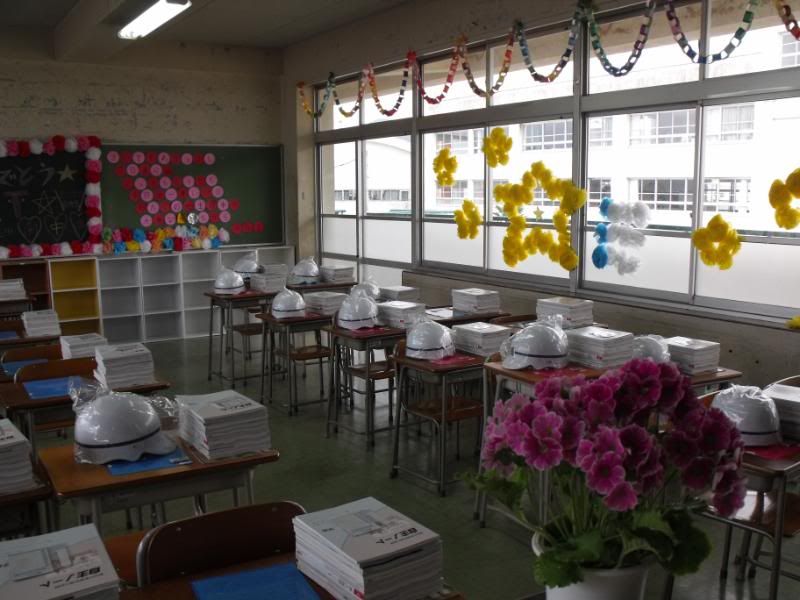
Now, for many, a new school year doesn’t mean much more than just a return to the same schedule after a short break. For others, like the 7 new teachers and 161 new students that just entered my junior high school, it means a brand new life. And in the case of the students,that includes 2 brand new uniforms, brand new gym clothes, a brand new school bag (which is an official school duffel bag and a complete change from the hard and sturdy backpacks they used for the last 6 years), 2 brand new pairs of shoes, and, of course, new teachers and new classmates.
Oddly enough, at least to me, beginning your time at a new school is so important that there’s a big entrance ceremony to commemorate the occasion. While it was rehearsed less than the graduation ceremony, it seemed to be much more important. At least, that’s the feeling I got from the parents. While there was a good crowd at the graduation ceremony, which was held barely a month ago, the entrance ceremony was packed. We had to put out more chairs to accommodate the happy and tearful parents. It also felt like it was more important because a lot more of the mother’s were dressed in kimonos, while the only kimono to be seen at the graduation was worn by one of the teachers.
Actually, now that I think about it, the level of importance of the two ceremonies seems to be complete opposite. What I mean is, the graduation ceremony was held in great reverence by the teachers and the school in general. There was a lot of prep time, the teachers were dressed to the nines, and it just felt like a very important occasion. While there were parents there, and they were dressed nicely, it didn’t seem like that big of a deal, especially when compared to the kind of reception a graduation back home gets. Then there’s the entrance ceremony. Very little time was spent getting ready for it, the rehearsal took thirty minutes, while the teachers were dressed nice, they weren’t dressed as nicely as they were for the graduation and it just felt like an average ceremony. But the parents came out in huge crowds, were dressed a lot more formally, and just seemed like this was one of the most important ceremonies that they could attend. Interesting how the two different parties put different levels of importance on the two ceremonies.
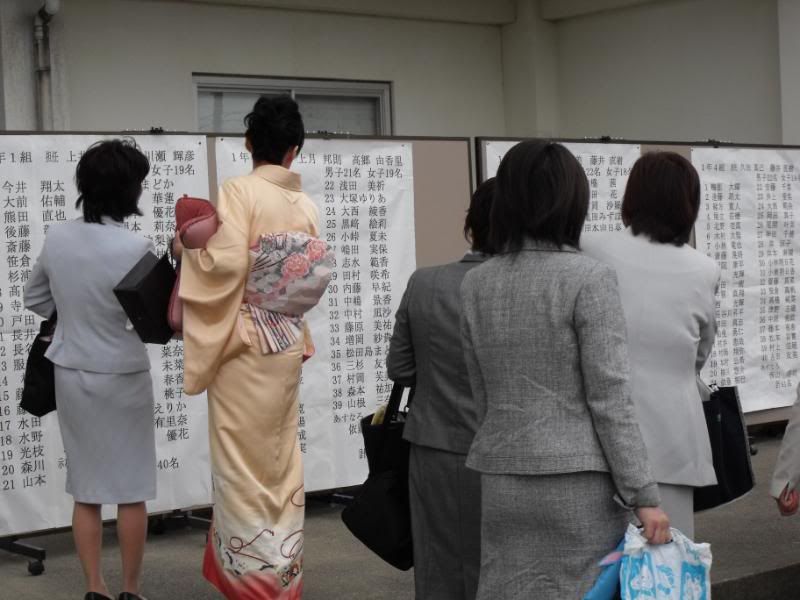
Speaking of the parents, it was really cute to see them get excited about the class placement of their child. Before a new school year begins, the teachers have a meeting and divvy up the students into equal classes. Right now, there are four classes for each grade at my school. Every year, the students are separated into different classes. It’s fun to watch the students crowd around the board that lists each class. There’s a lot of commotion; squeals of delight by friends who discovered that they’re in the same class, mummers of unhappiness from the students who are stuck with a less-than-favorite person, and just general pushing and shoving of people trying to find their name somewhere on the giant list. Today, not only did the first year students act this way, but their parents also did before entering the gymnasium and finding a seat. Many parents also took photos of their child’s name on the list, or a photo of someone pointing to their child’s name. It was quite entertaining to watch these groups of grown people act like, well, junior high students.
As for the new students... eee... they’re so cute! Some of them are so tiny they barely fit into their uniforms. But I know that won’t last long. They’ll fill them out before the year is done. Still, it should be a fun year. I can’t wait to get started!
Sunday, April 4, 2010
Cherry Blossom Parties
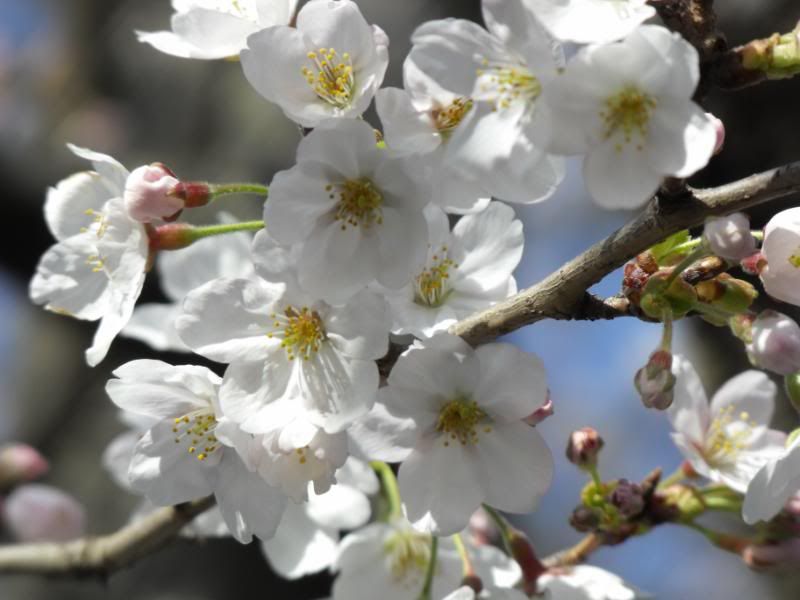
The sad thing about sakura trees is that their beautiful blossoms don't last for long. Within a week or so of their blooming, they will fall off of the trees in a storm of pink and white petals.
Since the beauty doesn't last long, people take time out to go and sit under the trees, usually with a picnic and some alcoholic beverages. Apparently this practice (known has hanami, or flower viewing) started in China and has since become very popular in Japan. Hanami is so popular in Japan that it's almost like a holiday season.
In Canada, or America, when the next upcoming holiday approaches, the stores are filled with items for that holiday and everything and anything comes out with holiday versions in order to celebrate. The same happens with hanami. The stores are filled with products to help you enjoy your picnic; like picnic baskets, tarps to sit on, temperature controlling bags for food or drinks and even mini-BBQs. Sakura themed products fill the shelves; dishes, chopsticks, boxes of beer, and even kit-kats. Also, to help with the planning of hanami events, the news has a sakura viewing forecast on after the weather. There are also quite a few websites dedicated to reporting on the blossoming around the country as well as tips about the best locations for sakura viewing.
If you ever want to visit Japan, I highly recommend coming at the end of March or beginning of April, when the sakura are in bloom. Its incredibly beautiful and there's nothing like a picnic under the trees with some good friends and a couple of cold drinks.
Wednesday, March 10, 2010
Graduation, Part 4: The Final Farewell
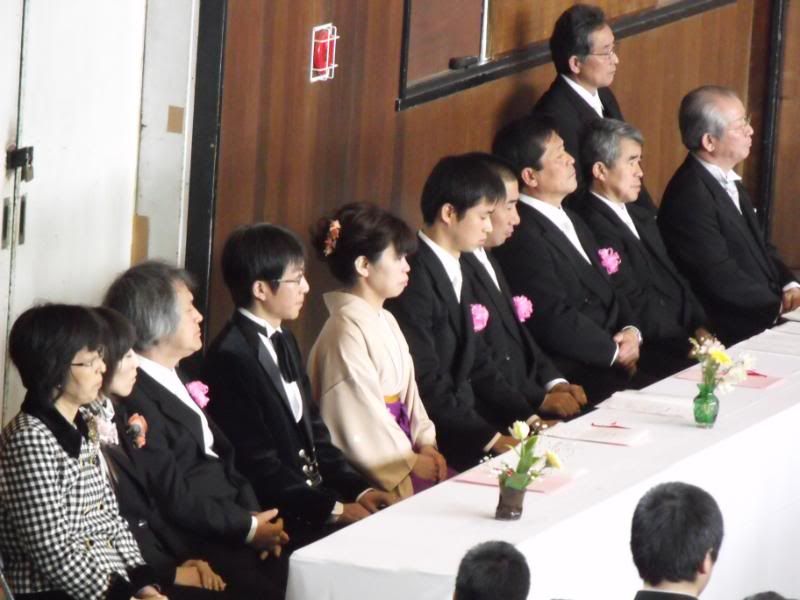
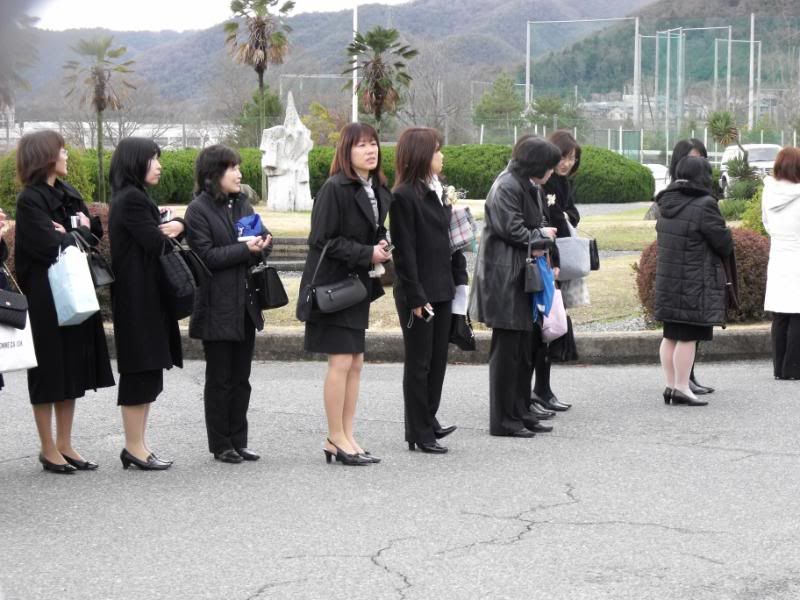
It turns out the ceremony is much more important to the family than I was lead to believe. A lot of families, not just the mothers, came. Everyone was dressed in their Sunday best, and a lot of women were wearing corsages pinned to their outfits. A few mothers were even drying their eyes as they watched their children walk out of off the school’s grounds for the last time.
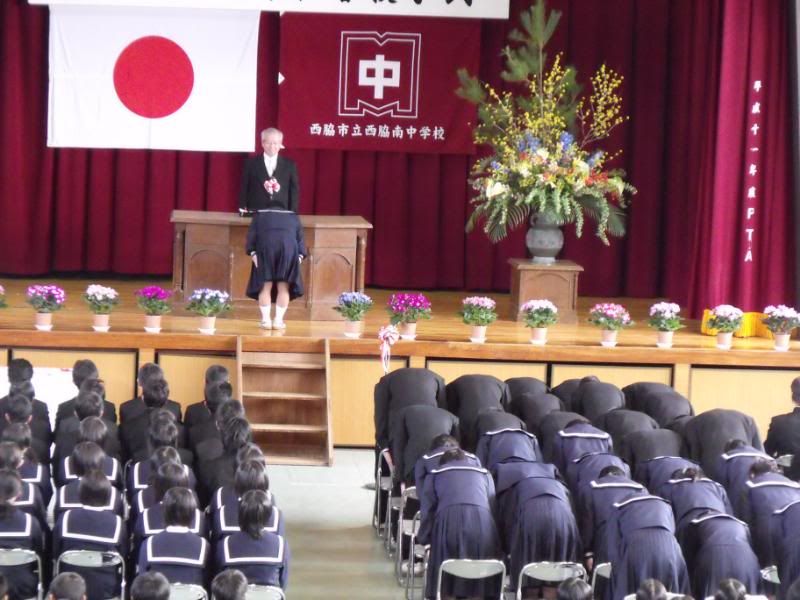
The ceremony was pretty much what I thought it would be, and was pretty much like a western graduation ceremony. There were long speeches, there was singing, and there was a lot of bowing. Actually, because they’re a bowing society, the only thing that really surprised me was that we didn’t clap after any of the speeches, only slightly bowed. This made the ceremony a lot more solemn and boring than some others that I’ve attended. There was no hooting and hollering as people stood to accept their diplomas. There was only a room full of quiet reverence. And the sound of camera shutters clicking.
All in all, it was a decent enough graduation ceremony. But note to self: dress up as much as you can next year. Since the students can’t dress up for this important occasion, it’s up to the teachers and parents to pick up the slack.
Graduation, Part 3: Singing
So it comes to no surprise to me that the school has its own anthem or that the students must sing a few songs at the graduation. Of course they will sing the school anthem, which I plan on memorizing before the ceremony, the traditional graduation song, and a special song the first year and second year students have been learning for the third years.
When I first heard the graduation song, you can imagine my surprise when I recognized the melody for “Auld Lang Syne.” The Japanese graduation song is called “Light of Fireflies” which is in reference to in the old days when students study by a jar of fireflies. Not sure why they didn’t use a candle, but the imagery is quite nice. Here’s the lyrics:
hotaru no hikari, mado no yuki. Light of fireflies, snow by the window,
fumi yomu tsukihi, kasane tsutsu. Many suns and moons spent reading
itsushika toshi mo, sugi no towo. Years have gone by without notice
aketezo kesa ha, wakare yuku. Day has dawned; this morning, we part.
tomaru mo yuku mo, kagiri tote, Stay or leave, either an end
katami ni omofu, chiyorozu no, Think as mementos; so many
kokoro no hashi wo, hitokoto ni, Corners of my heart, in one word
sakiku to bakari, utafu nari. Sing for peace.
There are two other verses, but these two verses are what my students sing. I think it’s quite pretty. Not as good as “Everybody needs Sunscreen” but a lot better than “Graduation (Friends Forever).”
Tuesday, March 9, 2010
Graduation, Part 2: On the Road to Perfection
I remember my graduation rehearsal: Is everyone here? Okay? Good. Line up in alphabetical order. Remember who you’re standing beside. Now we’ll walk in and sit down. Great. Now this is where you will walk when you get your diplomas. Got it? Great. Now get outta here.
Okay, maybe it wasn’t that cut and dry, but it was probably that quick.
My students’ rehearsal isn’t as simple: Okay classes, line up in alphabetical order, boys first and then the girls. Now we’re going to march into the gym. Class two, don’t enter until class one is at their chairs! Keep standing until everyone is here. Bow! No, you’re not bowing together. Again! Okay, sit down! Stand up! You’re too slow! Again! Bow! You’re standing up too fast! Again! Bow! Too fast! Again! Bow! 1…2…3… okay, now sit. No! Again! Again! AGAIN!
I can understand why they dedicated a whole hour to this. If the students don’t stand, bow or sit with just the right timing, they have to try again. If the students don’t bow low enough, a teacher will come and push their head down until they have reached the desired 90 degree angle. And there’s a lot of bowing happening.
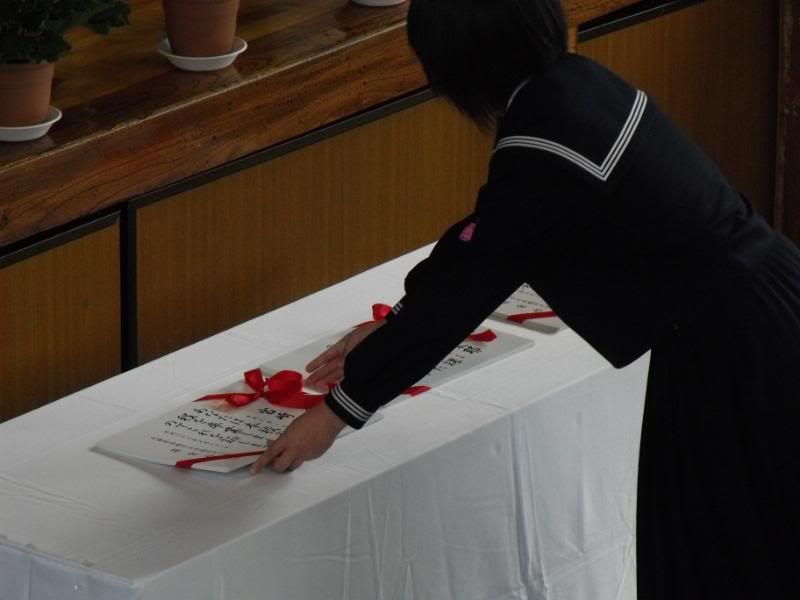
From what I can see, each student will not come up to the podium to receive their diploma from the principle. Instead, the class rep will be summoned and then he or she will make their way to the front of the stage, turn to the VIPs and bow, then turn to their homeroom teacher and bow, make their way up the stairs to the podium on the stage and then bow, in perfect sync with the rest of the class, to the principle, get the diplomas, make their way down the stairs, bow to everyone again, and then finally sit down. After the ceremony, the homeroom teachers will hand out the diplomas to the students in their classroom.
It’s not a lot of work, really, but the expectations are very demanding. The students seem to understand though. This is a very important day and they can’t embarrass themselves or their school. This is just what’s expected of them.
Graduation, Part 1: Who Cares
I’m still trying to figure out if graduation is a big deal in Japan. I know in Canada, or at least in my family, high school graduation is a pretty big deal. While the ceremonies are long and tedious, they are attended by many family members to help support the new graduate. But in Japan, the graduation ceremonies are held on a weekday, during school hours, and are maybe attended by the student’s mother. This lack of family support is why I don’t think they’re such a big deal.
But on the other hand, the ceremony does last 8 hours, there is a lot of prep work beforehand, and the younger students even put on a fun assembly for the graduating class prior to the graduation ceremony. And this is just for a junior high school graduation.
Then again, graduating from junior high might be as far as some of these students get. Not to say that any of my students are so dumb and apathetic that they won’t be able to make it through high school, but I’m referring to the fact that high school in Japan isn’t compulsory. I know a bunch of people I went to high school with (you know who you are) would have loved the option to get out of more schooling, but even though they don’t have to go to high school 94% of Japanese students do go on.
Is graduation a big deal in Japan? From the point of view of the school and the students, it is a very big deal. Last week I enjoyed a four hour assembly that featured the first year (grade 7) and second year (grade 8) students, as well as the teachers, dancing and acting in silly skits for the third year (grade 9) students. They sang, they danced, they bopped each other on the head, they fought evil and they never stopped saying “thank you,” to the third years. It was funny and a little sad at the same time.
So while the graduation may not be a big enough deal to get Dad or the grandparents to attend, it is a big deal. They just express it in different ways.
Monday, March 8, 2010
Hanko Very Much!
The reason it took me so long to get one is that I’m not Japanese. No wait, that’s not totally right. Okay, quick language lesson. The Japanese have three writing styles: two syllabic, and one that they got from the Chinese thousands of years ago. Basically every Japanese person’s name is written out in Chinese characters. This kind of hanko is incredibly popular and can be found anywhere, even at the dollar store.
Seeing as how I’m not Japanese I couldn’t really use one of those hankos, though I may buy one before I leave (I found some Chinese characters that sound out “Koren” and translate to “Forbidden Love,” how cool is that?). I could choose to either get my last name written out in the foreign syllabic writing style, or get it written out using the alphabet. The problem was that this is not something usually done, and no one in area knew where I could get one made. That is until I complained about it to my friends and they pointed me in the right direction. It’s so annoying to find out something you’ve been looking for has been right under your nose all along.
Long story short, I have a hanko! It makes me waaaaay too happy. I want to start stamping my students’ papers with it instead of the purple hello kitty stamp I bought for that purpose.
Sunday, February 14, 2010
How the Japanese do St. Valentine's Day
Sunday, February 7, 2010
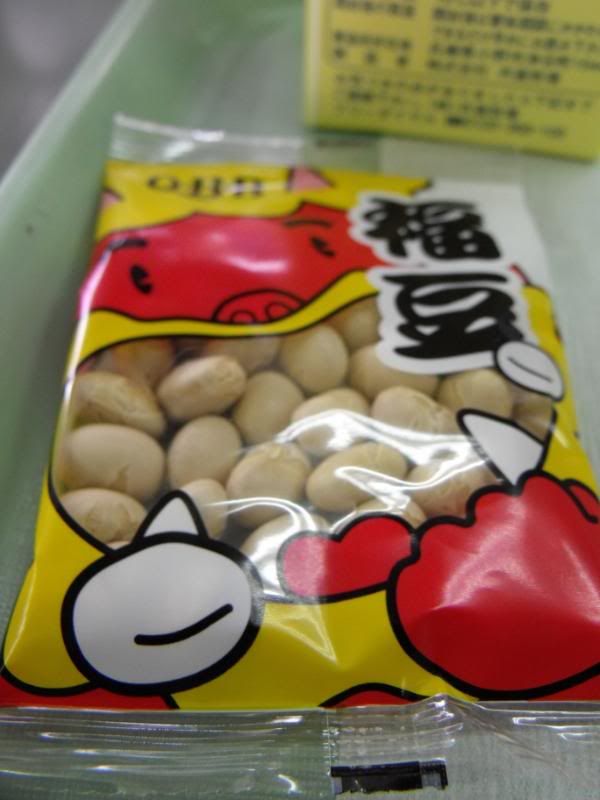
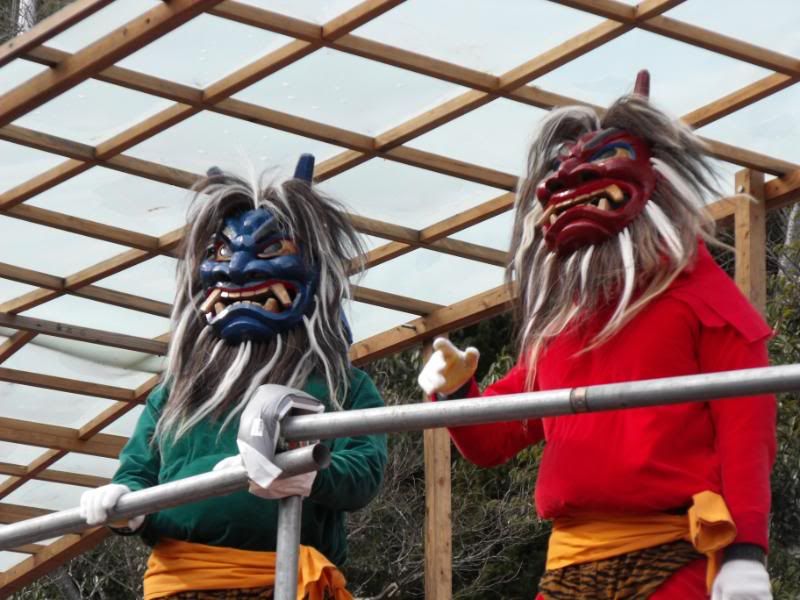
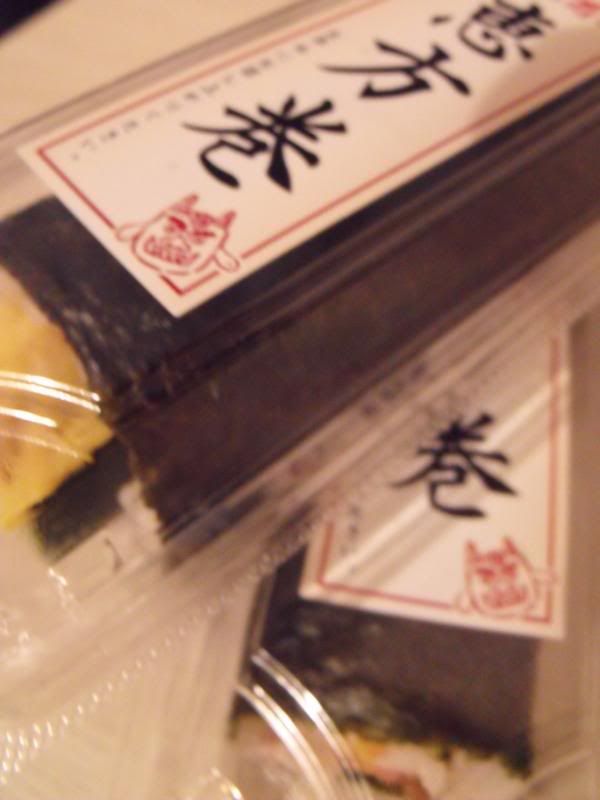
Setsubun; or, How I learned the art of bean throwing
Saturday, January 16, 2010
Live! From your Local Shopping Centre
Kamen Rider is a Power Rangers-type show, which features people transforming into power suits to fight evil muppets. Also, much like Power Rangers, each season has a new type of Kamen Rider. I don't know anything about this particular Kamen Rider, but the kids seemed to love him.
The show in general was cute and interesting. The host, a pretty girl who referred to herself as Nee-chan (Japanese for older sister or young lady) came on to the stage and talked to the kids for a bit. From their reactions, I would say she was doing typical pre-show hypes. Like "how are you?, "I can't hear you," and "Oh, I think I hear Kamen Rider coming!" Then, as his theme music played and all the children cheered, Kamen Rider came onto the stage.
The show was a short trivia show. Nee-chan asked 3 random trivia questions and 3 music questions. After the question was asked the audience had a few seconds to think about the answer and then they asked if anyone knew the answer. Little hands shot up into the air, complete with hopping and squeals of "oh, oh, me, me, please me!" Nee-chan picked someone, and, after they found their shoes (the audience was sitting on a mat covered floor in the center court, and since this is Japan, they had to remove their shoes), Kamen Rider helped them onto the stage. They introduced themselves, bowed to the crowd, and answered the question. Kamen Rider took a few suspenseful moments to decide if the answer was correct and then would turn to the child with one of his thumbs up. Nee-chan would happily cheer, "Bing-bong," the Japanese sound effect for a correct answer. Then the child was rewarded with a small toy. After all the questions were asked, the children had a chance to have their picture taken with the Kamen Rider. Of course, the Japanese parents were ready with cameras in tow.
While it wasn't the evil doer butt-kick show I was expecting, it was still fun to experience. After all, it's not everyday you get to see a superhero in person.
Here's a short video of Kamen Rider's entrance. There's no subtitles, cause, well, I don't know Japanese well enough yet to add them. Enjoy!
Sunday, January 3, 2010
New Years in Japan
So, needless to say, my Christmas in Japan was quite tame. I was lucky enough to have the day off, and I spent the time talking with family in Canada. I also went shopping to get a few last minute things for the Christmas dinner Kris and I had with our friends. It wasn't a bad Christmas, just not a Christmas I'm used too. There wasn't even any snow!
But don't think just because there wasn't a grand Christmas that Japan is lacking on holidays. They have more than enough of their own. For starters, they have two four-day holidays; one in the spring called Golden week, and one in the fall called Silver week. They also have a whole slew of holidays thrown into their year. So many that it seems like I have a stat-holiday at least once a month. But the big Japanese holiday is New Years.
Un
While they do enjoy the festival, the big thing is to make an offering at the temple, ring the bell, and pray for good fortune for the upcoming year. After the prayer, you can purchase a multitude of charms and horoscopes. If you have a horoscope that predicts misfortune, you tie it to a tree (or any spot that has been dedicated to this custom). Some shrines (like the one we went to) also offer other mini-shrines you can make offerings to and pray to. These shrines are dedicated to a certain cause. For example, if you are a student preparing for your entrance exams for high school or university, you might make an offering to a shrine for education.
Visiting the shrine is only one of the new years traditions. The other main tradition is the family time. Children (no matter what their age) return to their parents' home. They usually stay from the first until at least the third. During this time, no cooking or cleaning is supposed to be done. Which means that the poor mother is cooking like a mad woman on the thirty-first so that everything is ready for the upcoming feasts. I don't know a lot about these feasts, but I do know a bit about the food. One common new years food is zoni, which is a special vegetable and chicken soup. This soup is made with toasted mochi (rice cakes). We made it for our new years dinner and it was really yummy. Definitely something we'll make again.
Other foods that are common to new years are these boxes filled with different types of vegetables and seafood, like whole shrimp. The boxes should be assembled at home, but you can buy them from stores in advanced and have them delivered to your home either on new years or just in time for new years. But these boxes don't come cheap. The grocery store in the mall was selling them for about $100. I think I saw even some at 7-11 for $35. I don't know the full story, but each food has a special meaning, like long life or prosperity or something else depending on the food. Each thing is supposed to help bring good luck in the new year, and chase off evil spirits.
Since all this time is being spent with the family, a lot of places are closed until the 3rd or 4th. It's not as bad as I thought it would be. My bank's ATMs are open, but I've noticed a few that are closed. The big chain stores are open, but a lot of the smaller, family owned places are closed. The buses and trains are running, but a lot of them are running on a holiday schedule. Even some of the tourist destinations are closed.
The stores that are open offer "Happy Bags." Depending on the store and the items, a happy bag can go for $5-$100. They are filled with items from the store. Each store has signs and pictures of what is in the happy bag. I've seen happy bags filled with candy, clothes, picnic supplies and even stuff for the kitchen. Its a pretty cool idea, and one that works really well with another new years tradition: money envelopes.
I guess its okay that they don't have Christmas, because they have this tradition instead. On New Years day, parents give their children, under the age of 20, envelopes filled with money. From what I've been told, the older you are, the more money you receive. Many of my jr high school students will get $30-$50. The envelopes here are really cute, too. They have many different designs, from flowers, to the animals of the Chinese zodiac, to popular characters like Disney Princesses and Thomas the train engine.
The last tradition that I know about is New Years cards. The idea behind them is similar to Christmas cards. You buy, or make, cards that wish the people in your life good luck in the upcoming year. These cards are such a big deal that the post office guarantees delivery of your cards in time for new years as long as you drop them off by a certain time. The only major difference between these cards and our Christmas cards is that they don't sell them in bulk. Of course, in North America, you can go to almost any store and buy a box of Christmas cards for a few dollars. In Japan, you can buy new years cards from most stores or the post office, but they all go for 50¢ a card. Which can get really expensive really fast. I know the teachers I work with are buying them not only for their friends and family, but also for their homeroom students and students that are in the clubs that they supervise.
Japanese New Years might not be as awesome as Christmas is, but its still really interesting to experience this culture and enjoy their holidays and traditions.
Saturday, October 3, 2009
Sports Festival
First off, each sports festival starts off with an opening ceremony. Each grade and class (each grade has about 4 classes within it, with about 35 students in each class) marches around the field. They are lead by the student chairmen of the event, as well as some students who carry the school’s flag, the Japanese flag, and a banner that represents the theme of the sports day. During the march, the school band plays a nice marching tune the sets the mood.
Then there’s the actual events. Each race is a team event to help support the Japanese motto “it’s about the group, not the individual.” There were a bunch of different relay races and then the really cool races.
There was a really cool race called the caterpillar race. The classes were divided by their genders and raced from one end of the field to the other, and then back again. Here’s the catch, each team and one person who ran across the backs of their teammates. Once you’ve been run upon, you have to stand up, run to the end of the row, bend over and wait to get run upon once again. If the runner falls, the next person to be stepped on has to get on all fours and act as a step. It was a really interesting race to watch. Especially since I knew nothing like this would ever happen in Canada.
There was another cool race to watch. Each class was lined up in rows of four. A group of four would hold onto a giant bamboo rod, run to the other end of the field, go around two pylons, and run back. When they got back to their team they had to drag the rod under their team, who jumped over it as it came, and then bring it to the front and hand it off to the next group of four.
There were also some tug of war games and a two-legged type of race, only the whole team was tied to each other.
The other events were much larger events that took a lot more time to practice.
The grade 8 & 9 girls did two really good dances that are based on a very popular dance style in Japan called Para Para. It’s like line dancing, but it’s more for a group and focuses mostly on arm and hand movements rather then leg movements. It was very well done, but the girls weren’t smiling. A few of the female teachers and I tried to get them to smile while they danced, but they were too busy concentrating on the dance movements to think about smiling. Oh well…
The grade 7 kids performed a traditional Japanese dance. Tradition Japanese dances are always based on some sort of work. This one was based on being fishermen. Their actions represented pulling in the nets and throwing the fish into the boats. Or at least, that’s how it was explained to me. I found it really cute cause there was a lot of “e-yah”s shouted, and the grade 7 students have very high pitched voices.
The, for lack of a better term, gymnastics that the grade 8 & 9 boys did were simply amazing! They displayed such feats of strength and agility and danger that I know would never be allowed in a school function anywhere in North America. One thing they did was a simple pyramid made up of 6 students. Wanna know how they got down? They just flattened themselves and fell onto the sand below. And that field is all sand. All the way down. Another amazing feat was called the fan. It included 5 people, one in the middle holding the other four up who were leaning towards the group. My favorite was called the wave. A group of boys got on their knees, locked arms and moved as a group to simulate the movement of a wave across the horizon. Then the coup de grace was a 7 layer pyramid, with the boy on top standing and holding a banner. The banner the top boy held said something about the school celebrating its 50th anniversary. Those boys actually climbed on top of each other to get to their spots, and then climbed back down again. Which is good, cause I think one boy went home one day with a broken rib or something from falling from one of these stances.
It’s probably a good thing we don’t try this stuff back home.
So that was the sports festival. It was so interesting to watch and learn more about Japan through this activity. And after wards I got to go to a dinner party with my co-workers and watch them make their own pyramid in the restaurant after they had one too many drinks. Yeah, I work with a crazy bunch.
PS - Sorry there's no pics, but I promised my principal that I wouldn't post them on the Internet.
Tuesday, September 1, 2009
Culture Shock
1. The kids are kids: The Jr High girls are sweet and innocent, complete with ponytails. If they're trying to be anything, they're just trying to be cute, unlike their North American counterparts, who are busy trying to be dirty be-autches.
2. Shopping: You pack your own stuff. Yeah, not too different from some places in Canada, but how they go about it is different. You bring your basket to the cashier, who takes an empty basket and puts it on the counter. They then take items out of your basket, scan them and stick them in the new basket. Once they're done that, they hand you a bag or two, you pay, and then you move down to the packing station. The packing station even comes with those little bags you use to wrap your veggies and fruit in. Also, when you're in a grocery store, if you buy anything that needs to stay frozen and cold, you're directed to a dry ice machine and you use to fill the bag with your frozen goods in it. It's so cool!
3. Taxi: Small fact, the taxi's have doors that automatically open and close. They look and work like a regular door, in the fact that they swing open, but the driver has a button he presses to open and close the door.
4. Bikes: Bikes seem to be the major mode of transportation here in the land of the rising sun, and man, do they have it down to a science. The kick-stand on my bike back home was not a sturdy or reliable device. In fact, I spent many weekends tightening it. Here though, the kick stand is not just a thin piece of metal that has to rely on physics to keep your bike from falling over. It's a larger piece of metal that goes under your back wheel and keeps the whole thing from tipping over. Then there's the bike lock. It's a little half circle that's attached to the back wheel that comes with a key that needs to be in the lock while the bike is in use. This is extra helpful to those of us who are prone to losing things. Like keys. Sorry if these wordy descriptions are not enough to paint a proper picture. I'll try and take photos of my bike tomorrow.
5. The blind: I have yet to see a blind person, but
That's all for today, but as I explore this vast land, there will be more tales and other comparisons.